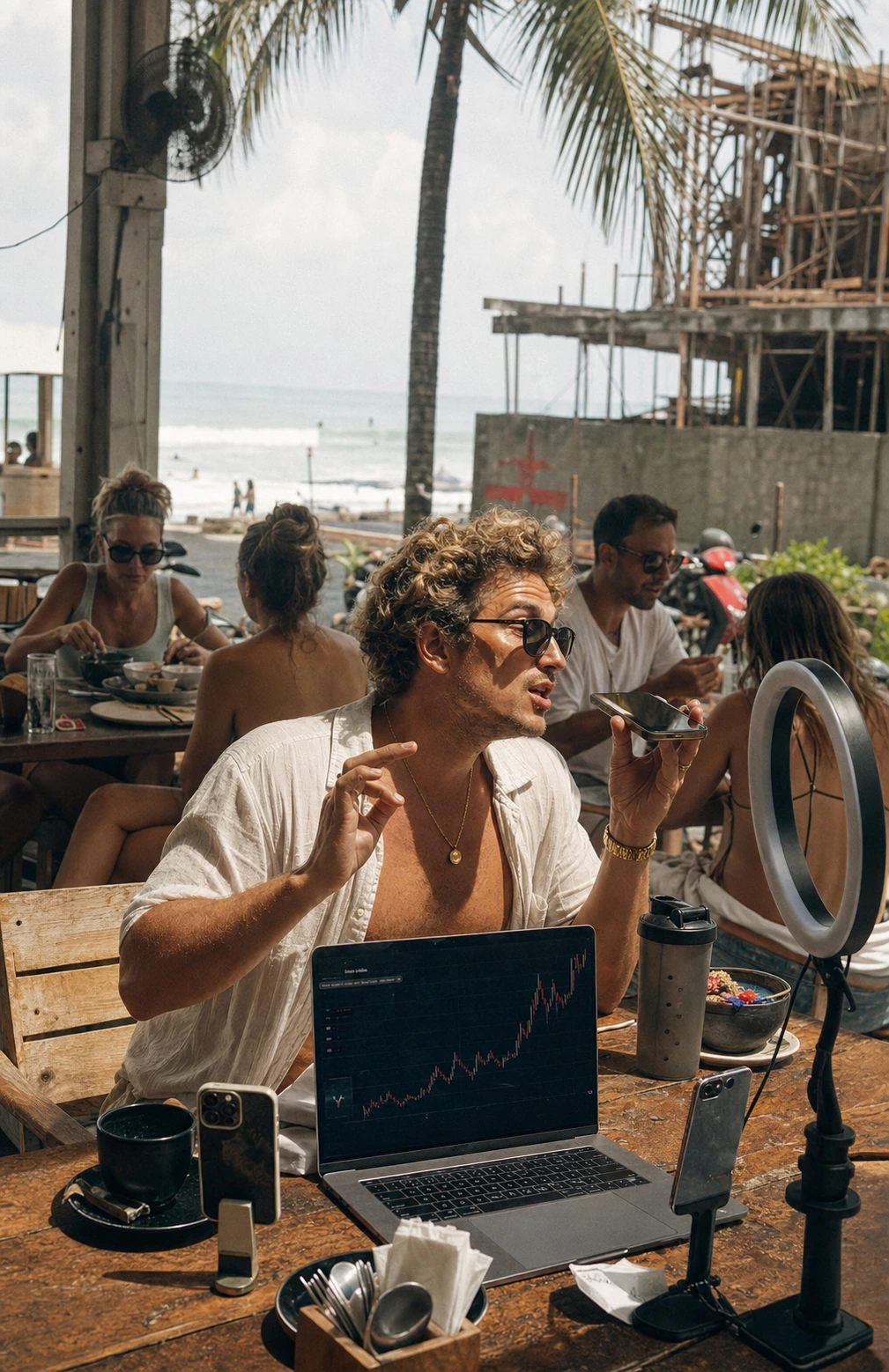
The market prophet
One beach café. Three phones. Everyone hears the prediction.
He found freedom. It apparently requires a ring light, an open laptop, and a voice note played at full volume.
Personal note Why Touristn’t exists
You get excited. You book the flight. You picture the quiet beach, the strange little restaurant, the feeling of discovering somewhere on your own terms.
Then you arrive at the content set.
Meet the neighbours ↓01 / The problem
The joke is not on how anybody looks or where they come from. It is on the performance: every café as an office, every view as a set, every peaceful moment as raw material.
He found freedom. It apparently requires a ring light, an open laptop, and a voice note played at full volume.

The whiteboard says freedom. The tripod says nobody else is getting past the sun loungers.
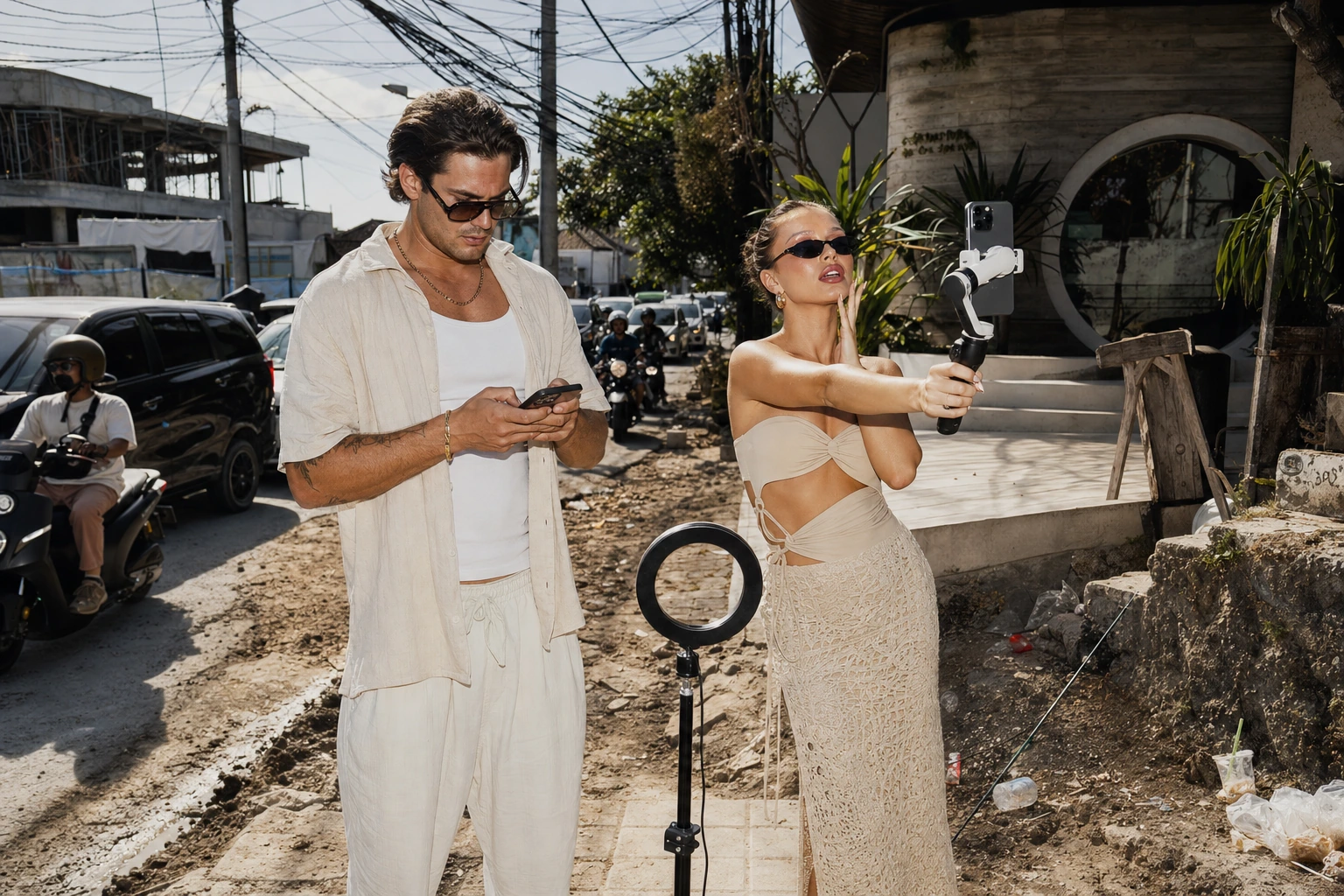
Traffic, construction, and everybody else disappear just outside the frame. The fake-candid pose gets another take.
All scenes are AI-generated editorial composites. No real person is depicted, and no individual is being accused of anything.
02 / The part that bothered me
The beautiful beach is still there. So is the food, the landscape, and the reason people came in the first place.
But when the same few coordinates absorb everybody’s attention, prices rise, queues form, and local character gets replaced by whatever performs best in a nine-second video.
You pay more to feel less.“The Bali of 30 years ago.” Not empty. Not undiscovered. Just not yet flattened by the feed.
I wanted a way to share the places that still give you what famous destinations originally promised: beauty, character, generosity, surprise, and enough room to experience them.
Places where the value is the same—or higher. Where fewer tourists means more choice, more calm, and the quiet pleasure of having made a less obvious decision.
That is the feeling Touristn’t is built to protect: not bragging that nobody else knows, but knowing why your trade-off is better.
04 / The filter
Publishing a “secret spot” is how you stop it being one. So I would rather show the trade-offs—and help you choose with taste.
Equal or better—not expensive simply because the place is famous.
Fewer people competing for the same view, table, road, and patch of sand.
Enough space to notice where you are instead of managing the queue.
A little harder to reach. Often that is exactly why the trade-off still works.
Touristn’t doesn’t tell you where nobody goes. It tells you where everybody is wrong.